
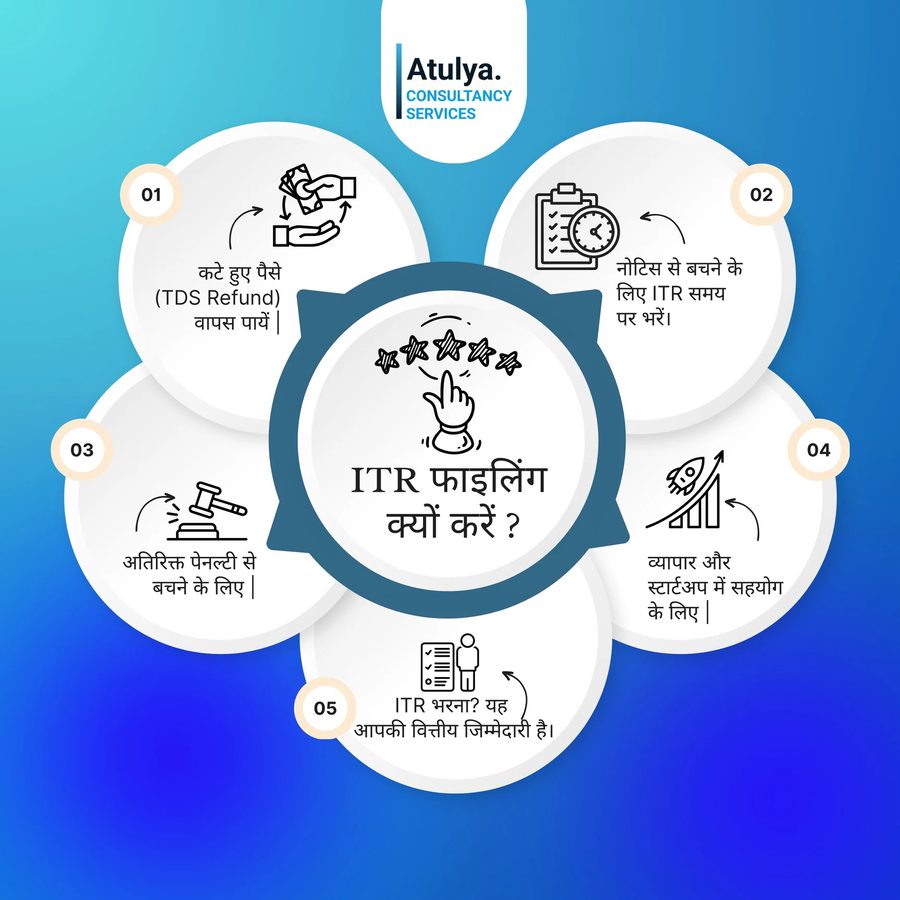
Every July we hear the same question across our desk: “My income is below the limit — do I still need to file a return?” Legally, you may not have to. Practically, you almost always should. Here are the five reasons printed on the poster in our office, and a few details that go with each one.
1. Get back the tax that was already cut
Banks deduct TDS on fixed-deposit interest, employers deduct it on salary, and businesses deduct it on rent, commission and professional fees — often without checking whether your total income is taxable at all. The only way to get that money back is to file a return and claim the refund. The department pays refunds straight into your bank account, with interest where the refund is delayed.
Check Form 26AS and your Annual Information Statement (AIS) on the income-tax portal. If they show TDS against your PAN and you haven’t filed, there is probably a refund waiting for you.
2. Avoid notices and penalties
Filing becomes compulsory once your gross income crosses the basic exemption limit — and that is before deductions such as 80C, so many people who owe no tax are still required to file. The law also requires a return from some people whose income is below the limit, for example when:
- you deposit more than ₹1 crore in current accounts during the year,
- you spend more than ₹2 lakh on foreign travel, or more than ₹1 lakh on electricity,
- your TDS and TCS together cross ₹25,000 (₹50,000 for senior citizens),
- you hold assets abroad or earn income from outside India.
The department sees your high-value transactions in the AIS. When those don’t match a filed return, a notice follows. A late return also carries a fee of up to ₹5,000 (₹1,000 if your total income is up to ₹5 lakh).
3. Proof of income for loans, visas and tenders
Your ITR acknowledgement is the most widely accepted proof of income in India. Banks ask for the last two or three years’ returns before sanctioning a home, car or business loan. Embassies ask for them with visa applications, government departments ask for them in tenders, and insurers use them to decide how much term cover they will give you. A self-employed person with no returns on file often finds these doors simply closed.
4. Carry your losses forward
Made a loss in business, or on shares and mutual funds? You can set it off against future profits — but only if you report it in a return filed by the due date. Miss the deadline and most losses are gone for good (a loss from house property is the main exception). For traders and investors, this alone can be worth far more than the effort of filing.
5. It builds your financial record
Filing every year, even with nothing to pay, creates a clean, continuous record of your income. It helps when you register a business, apply for a startup scheme or a subsidy, or need to show the source of money you used to buy property. As our poster puts it: filing your ITR is part of your financial responsibility.
When and how to file
For most individuals who don’t need a tax audit, the due date is 31 July after the end of the financial year, unless the government extends it. A belated return can be filed later, with a late fee. Keep these ready:
- PAN, with Aadhaar linked to it.
- Form 16 from your employer, if you are salaried.
- Bank statements and interest certificates for the year.
- Form 26AS and the AIS downloaded from the income-tax portal.
- Proof of any investments, insurance premiums or donations you want to claim.
Send these to us on WhatsApp and our income-tax team will pick the right ITR form, check every figure against the AIS and file it for you — usually the same week.
This article is general guidance based on the rules in force on its publish date, not professional advice for your specific case. Tax and company rules change often — check your situation with us before you act.